It usually doesn’t start with something big.
Maybe it’s a missing drill. A couple of cables that no one remembers moving. Someone shrugs it off—“probably misplaced.”
But then it happens again.
And again.
Until one day, the generator is gone. Or an entire shipment of materials disappears overnight. And suddenly, what seemed like small, isolated incidents revealed a much bigger problem.
Construction site theft isn’t just an occasional headache anymore—it’s become a serious, widespread issue that’s quietly costing companies millions. In some regions, billions.
What’s more concerning is that most of these losses don’t come back. Once equipment or materials leave the site, they’re often gone for good.
And this isn’t random anymore.
It’s planned. It’s organized. And it’s evolving faster than many job sites are prepared for.
But here’s the flip side—some sites are starting to fight back. And they’re doing it in smarter ways than ever before.
How Construction Site Theft Has Evolved
There was a time when construction theft was mostly opportunistic.
Someone passing by might grab an unattended tool. Or maybe a worker quietly took something home. It happened, sure—but it wasn’t systematic.
That’s changed.
It’s No Longer Random
Today, a lot of construction theft is carried out by organized groups. These aren’t people acting on impulse—they plan ahead.
They watch job sites. They learn schedules. They figure out when a site is empty, when deliveries arrive, and where high-value materials are stored.
And then they strike—quickly and efficiently.
High-Value Materials Are the Main Target
It’s not just tools anymore.
Copper wiring, electrical components, heavy equipment—anything that can be resold quickly is a target. Copper, in particular, has become one of the most commonly stolen materials because of how easy it is to sell.
And as new technologies enter construction—like solar panels—those are starting to attract attention too.
Timing Is Everything
Modern thefts are rarely random. They’re timed.
- Late at night
- Over weekends
- During holidays
- Right after material deliveries
Basically, whenever a site is least active.
In some cases, entire sections of a site are cleared out before anyone even realizes something’s wrong.
It’s fast, calculated, and increasingly hard to catch using traditional methods.
Why Traditional Security Is Failing
If theft is getting worse, it’s fair to ask—why aren’t current security measures stopping it?
The truth is, most job sites are still relying on systems that were designed for a completely different kind of threat.
Fences and Locks Aren’t Enough
Fencing, padlocks, and basic guards used to work as deterrents.
Now? Not so much.
For someone determined—and prepared—these are just minor obstacles. They slow things down, but they don’t stop anything.
No Real-Time Awareness
One of the biggest issues is visibility—or the lack of it.
Most sites don’t actually see what’s happening after hours. They find out the next morning… or sometimes days later.
By then, it’s already over.
Insider Access Complicates Things
Not all theft comes from outside.
Sometimes it’s people who already have access—workers, subcontractors, or vendors. Without proper tracking or accountability, it becomes very difficult to pinpoint what’s happening.
The Nature of Construction Sites
Let’s be honest—construction sites aren’t easy to secure.
They’re often:
- Large and spread out
- Poorly lit
- Located in remote or developing areas
That combination makes them naturally vulnerable.
So when you pair evolving threats with outdated security, it’s not surprising things are slipping through the cracks.
The Real Cost Beyond Stolen Materials
When people think about theft, they usually focus on what was taken.
But the real cost goes much more than that.
Delays That Ripple Through Everything
When materials disappear, work stops. It’s that simple.
Teams can’t move forward. Schedules shift. Deadlines get pushed back.
And in construction, delays don’t just affect one part of a project—they affect everything.
Hidden Costs Add Up Fast
Replacing stolen items is just the beginning.
There’s also:
- Rush orders for replacement materials
- Overtime to catch up
- Equipment rentals
- Administrative headaches
Before you know it, the “real” cost is far higher than the value of what was stolen.
Insurance Gets Complicated
Frequent theft doesn’t go unnoticed by insurers.
Premiums go up. Coverage becomes stricter. In some cases, claims become harder to process.
Smaller Companies Feel It More
For large firms, theft is painful.
For smaller contractors, it can be devastating.
One major incident can throw off cash flow, delay multiple projects, or even force temporary shutdowns.
Reputation Takes a Hit
Clients expect reliability.
When projects are delayed or disrupted, trust erodes. And in this industry, reputation matters—a lot.
How Smart Job Sites Are Fighting Back
The good news is, things are started to change.
Forward-thinking construction companies are no longer relying on outdated methods. They’re turning to smarter, more proactive solutions.
Seeing What’s Happening—In Real Time
Instead of discovering problems after the fact, smart job sites monitor activity as it happens.
Cameras, sensors, and remote monitoring systems allow teams to actually see what’s going on—even when no one is physically there.
Layered Security Instead of One Solution
There’s no single fix.
Smart sites combine multiple tools:
- Surveillance systems
- Motion detection
- Access control
- Alarm systems
It’s about creating layers—so even if one thing fails, others are still in place.
Using Data to Stay Ahead
This is where things get interesting.
Modern systems don’t just monitor—they collect data.
That means companies can start to identify patterns:
- When theft attempts are most likely
- Which areas are most vulnerable
- What times need extra attention
Security becomes less reactive—and more strategic.
Managing Everything Remotely
With cloud-based systems, site managers don’t have to be physically present to stay in control.
They can check in, receive alerts, and respond instantly—from anywhere.
Deterrence Plays a Big Role
Sometimes, just knowing a site is being actively monitored is enough to discourage theft.
Visible cameras, proper lighting, and clear signage send a strong message: this site isn’t an easy target.
What an Effective Modern Security Setup Looks Like
So what does “good” security actually look like today?
It’s not just about having cameras or guards—it’s about how everything works together.
Strong Perimeter Control
You still need physical barriers—but smarter ones.
- Controlled entry points
- Sensors on access areas
- Clearly defined boundaries
Smart Surveillance
Not just cameras—but intelligent ones.
Systems that can detect unusual activity, work in low light, and provide clear, usable footage.
Instant Alerts
Timing matters.
The faster you know something’s happening, the better your chances of stopping it.
Controlled Access
Knowing who enters and leaves the site—and when—is critical.
Digital logs and restricted access points help reduce both external and internal risks.
Proper Lighting
It sounds simple, but it makes a huge difference.
Well-lit sites are far less attractive to thieves.
Asset Tracking
Knowing where your equipment is at all times adds another layer of control.
If something moves when it shouldn’t—you know immediately.
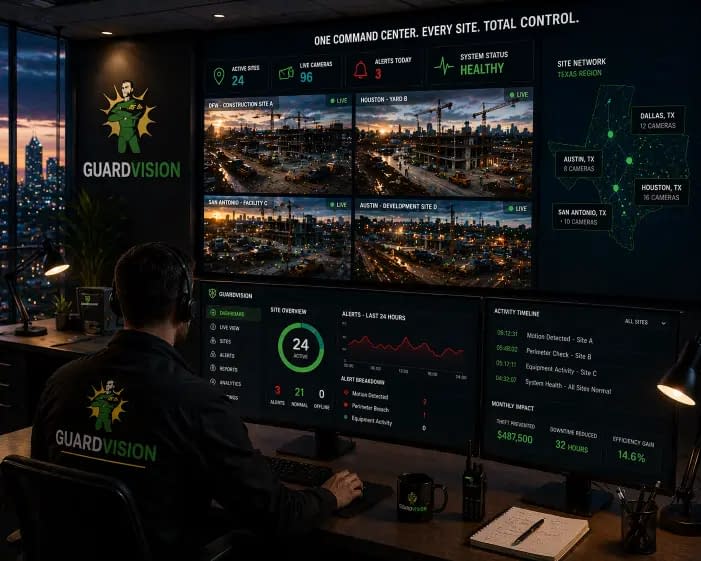
Centralized Control
Bringing everything into one system makes it easier to manage.
Instead of juggling multiple tools, everything can be monitored from a single dashboard.
Construction site theft isn’t slowing down.
It’s becoming more sophisticated, more organized, and more costly with each passing year.
What used to be a minor inconvenience has turned into a multi-million dollar crisis—impacting timelines, budgets, and entire businesses.
But the shift toward smarter job sites offers a clear path forward.
By adopting modern, technology-driven security solutions, construction companies can:
- Reduce risk
- Protect assets
- Maintain project timelines
- Safeguard profitability
The question is no longer if you need better site security.
It’s how soon you’re willing to act.
Because in today’s environment, the most secure job sites aren’t the ones with the highest fences—
They’re the ones that are smartest.