THE SHORT ANSWER
Cargo theft risk is highest at the start of the holiday window, and it stays high through the days after Christmas. In CargoNet’s five-year review of Dec. 23 to Jan. 2, Dec. 23 was the busiest single day, and about 69% of events came between Dec. 23 and Dec. 29. CargoNet links the risk to closures, thinner staffing and loaded freight sitting longer. To protect a yard or warehouse, tighten pickup checks, shorten how long loaded trailers sit, test your cameras and alerts, and decide who responds while the site is quiet.
Picture a truck yard on Dec. 26. Half the office is off. The dock is closed. Three loaded trailers are waiting for pickups that were booked before the break. Nobody is sure who is on call.
That quiet is what thieves look for. This guide is for operators of truck yards, depots and warehouses in the United States, with a plan built around the Dec. 23 to Jan. 2 window. It is not a full yearly security review. For the wider 2025 to 2026 numbers and how fake pickups work, read our cargo theft guide for warehouse and yard operators.
What the holiday data shows
Verisk CargoNet reviewed five years of holiday-window activity. It counts “events” as cargo theft incidents, theft of tractors and trailers, and supply chain fraud. Here are the main findings, as CargoNet published them.
01
Dec. 23 is the peak
56 events, about 16% of all 353 events in the five windows.
02
The week is front-loaded
About 69% of events fell on Dec. 23 to 29. About 53% fell on Dec. 26 to 30.
03
Events grew over time
From 49 in the 2020 window to 89 in 2024, about 82% more.
Texas is part of this picture. It had 41 events in the five-year window, second to California’s 84, and ahead of Illinois and Florida at 32 each. That is about 12% of the 353 total, by our calculation.
Read these numbers with care. They are national counts of reported events over five holiday windows. They do not give a theft rate for your yard, and they do not show that Texas risk is rising. Use them to decide when to be extra careful, not to predict what will happen at your site. CargoNet’s reported commodities of interest included tires and auto parts, alcohol, televisions, computers, power tools, footwear and major appliances. Source: Verisk CargoNet, December 2025.
Why Christmas to New Year’s is different for freight yards
CargoNet names three conditions that create openings: holiday closures, reduced staffing, and more time that loaded freight sits waiting. Each one is easy to see at a yard.
- Closures: gates, offices and docks run on short hours or none, so fewer people notice something odd.
- Thin staffing: the people on duty may be new to the job, covering for others, or still learning the pickup rules.
- Dwell time: loads booked before the break may wait days for a pickup, and a loaded trailer that sits is an easier target than one that moves.
In 2026, Christmas Day and New Year’s Day both fall on a Friday, so many sites will have two long weekends back to back. Check your own calendar for the exact closure dates.
A day-by-day plan for the holiday window
Because the risk is front-loaded, the work should be too. Use this as a starting point and change it to fit your operation.
| When | What to do | Why now |
|---|---|---|
Before Dec. 23 |
Finish pickups early where you can. Review which loaded trailers will sit through the break. Test cameras, lights and alerts. Share the closure plan and contact list. | Dec. 23 is the busiest day in the data, so the plan must be live before it. |
Dec. 23 to 25 |
Hold the line on pickup checks. Confirm each driver and carrier by calling a number you already have on file. Keep gates and docks on a written schedule. | The opening days carry the highest single-day count. |
Dec. 26 to 30 |
Treat this as the main risk stretch. Confirm who answers alerts, who can visit the site, and who checks in with drivers on long stops. | About 53% of events fell in this five-day stretch. |
Dec. 31 to Jan. 2 |
Keep the same rules. Do not relax because the new year feels like a restart. Record any odd visits or calls. | The window ends Jan. 2, and staffing is often still thin. |
First day back |
Walk the yard. Compare trailers and doors with your list. Check the gate, fence and camera log for gaps. Write down what to fix before next year. | A loss found late is harder to trace. |
If you also run a construction site, the holiday shutdown security checklist for construction sites covers the jobsite side of this same break.
Printable holiday cargo security checklist
Use this with dispatch, the dock lead and whoever holds the keys. The steps follow CargoNet’s published advice and common yard practice. Write a name and date next to anything that needs work.
Pickups and paperwork
Verify every pickup and every change by calling back a number you already have on file, not one in the request.
Set driver check-in times for any long stop or extended dwell.
Trailers and the yard
Move loaded trailers out before the break where you can, to cut dwell time.
Park the loads that must stay inside the fence, in well-lit, well-watched spots.
Check locks, lighting and any damaged fence or gate sections before the window opens.
Cameras and alerts
Test the cameras, then send a test alert and confirm who receives it.
Decide what happens if the first person does not answer.
People and response
Name one on-call person and a backup for each day, and post the list where the dock team can find it.
Report suspicious activity promptly to local law enforcement and to CargoNet.
Have LTS, GeoVision or UniFi cameras already?
GuardVision can monitor LTS, GeoVision and UniFi camera systems at commercial sites anywhere in the U.S., so someone reviews alerts during the quiet hours.
What should you use: guards, cameras, or both?
A checklist handles the paperwork. It does not watch the yard at 2 a.m. Match the tool to the gap.
| If your yard has... | Consider | Limit to know |
|---|---|---|
No one on site at night |
Live monitoring of existing cameras, or a guard for the hours that matter | Monitoring needs supported cameras, a connection and a response plan. A guard covers only their shift. |
No cameras, power or internet in part of the yard (Texas) |
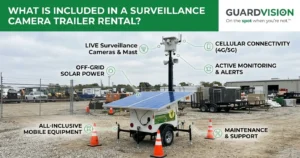
Titan Solar, a solar-powered mobile security camera trailer, or Titan, a battery or generator-powered mobile security camera trailer | Trailers are sold, rented and serviced in Texas only. Cameras cannot check a driver’s paperwork. |
A permanent need all year |
A fixed camera system, with monitoring added if you want live review | Plan the install well before the holiday, not during it. |
Fake-pickup risk |
Written pickup checks and call-back rules | No camera replaces this step. |
For Texas yards that need cameras quickly, the Texas mobile security camera trailer page explains rental and purchase. Ask about delivery lead time now, because dates close up fast before the break. For the full picture of what monitoring does and does not do, read what remote video monitoring is.
What this plan cannot promise
No plan removes cargo theft risk. A warning from a monitoring agent does not stop everyone, and no provider can promise whether or when police will arrive. A camera cannot tell you whether a pickup request is real. The goal is simple: make your yard harder to approach and make sure someone sees and acts when it counts.
What live monitoring needs before it works
Monitoring is only as good as its setup. At a minimum:
- Supported cameras. GuardVision monitors LTS, GeoVision and UniFi camera systems at commercial sites, including systems another company installed. Other brands usually need to move to a supported platform.
- Cameras that cover the ways in, with clear images at night.
- A steady connection that can stream video when an alert fires.
- A written response plan: who is allowed on site, who to call and when to call the police.
A speaker lets an agent talk to the person. Without one, an agent can still check and escalate, but cannot speak on site. For the full list, see what you need for remote video monitoring.
Frequently asked questions
When is cargo theft risk highest over the holidays?
CargoNet’s five-year review of the Dec. 23 to Jan. 2 window found the single busiest day was Dec. 23, with 56 events, about 16% of the total. About 69% of events fell between Dec. 23 and Dec. 29, and about 53% between Dec. 26 and Dec. 30. These are national counts, so treat them as timing guidance, not a forecast for one yard.
What does CargoNet count as a holiday cargo theft “event”?
For this analysis, CargoNet counts cargo theft incidents, theft of tractors and trailers, and supply chain fraud activity. That means some events are fake pickups or false instructions, not only break-ins at a fence.
Is Texas a high-risk state for holiday cargo theft?
In CargoNet’s five-year holiday-window review, Texas had 41 events, second to California’s 84 and ahead of Illinois and Florida at 32 each. That is a count of reported events, not a theft rate for Texas yards, and it does not show that Texas risk is rising.
Can security cameras stop a fake pickup?
Not on their own. A fake pickup can look like an ordinary visit, so the key defense is checking the carrier, driver and appointment through numbers you already have on file. Cameras and monitoring help with what happens in the yard, and give you a record of who was there.
Can GuardVision monitor the cameras my yard already has?
Yes, if they are LTS, GeoVision or UniFi systems at a commercial site, even if another company installed them. GuardVision checks your exact cameras first. Other brands usually need to move to a supported platform.
Can I get a GuardVision camera trailer outside Texas?
No. GuardVision sells, rents, installs and services trailers in Texas only. Remote video monitoring for supported camera systems is available at commercial sites nationwide.