THE SHORT ANSWER
There is no single purchase price for a security camera trailer, because the cost depends on the site. GuardVision doesn’t list one fixed price. Instead, ask for a written quote that splits the cost into three parts: the equipment price, the cost to get it working and the cost to own it over time. Trailers are sold and installed in Texas only, and you can ask for a quote for your Texas site.
A construction manager may need a trailer at a remote jobsite with no power. A yard owner may have steady electricity and one entrance to watch. Both ask, “What does a camera trailer cost?” But they aren’t buying the same system.
This guide covers buying and ownership costs only. If you’re still choosing between renting and buying, start with how to decide whether to rent or buy a security camera trailer. For rental prices, see what it costs to rent one in Texas.
The three prices to ask for
Instead of placing cameras or guards wherever there is room, walk the property with a simple map. Mark the areas where people, vehicles, and deliveries meet. The four zones below are an example, not a map of a real GuardVision customer site.
| Price to ask for | What it means | What to check |
|---|---|---|
1. Equipment |
The trailer and the hardware in the purchase | Cameras, mast, solar panels, battery, modem, lights, speaker, recorder |
2. Ready to use |
Getting it working on your Texas property | Delivery, placement, camera aiming, connection tests, account setup |
3. Ownership |
What you spend after you buy | Data, software, monitoring, service, moves, insurance, wear |
If a seller gives you only the first number, you can’t yet compare that quote with a ready-to-use package.
What changes the purchase quote
Here are the main parts of the quote, and the question to ask about each one.
| Part of the quote | What changes it | Ask this |
|---|---|---|
Trailer and power |
Site electricity with battery backup, or solar panels and batteries | Which power setup fits my site, and what happens after several cloudy days? |
Cameras and detection |
How many cameras, fixed or movable views, night vision, and software that flags people and vehicles | Can I see a drawing of each camera’s view, and a night sample? |
Warning devices |
Floodlights, strobes, a siren and a speaker for live voice warnings | Which are installed, which are set up, and which are options? |
Connection and video |
Cellular equipment, the data plan, where video is stored and any software renewals | How long is footage kept, and what stops working if a subscription ends? |
Mast and placement |
Mast height, ground conditions and where the trailer sits | Can the cameras see the entrances and the areas that matter? |
Delivery and setup |
Distance, site access and how soon you need it | Are delivery, setup and testing on the same quote as the trailer? |
Warranty and service |
What’s covered, for how long, and who does the repair | What happens if a camera or battery fails in month 14? |
Payment |
Paying in full, financing or leasing | What do all the payments add up to? |
More cameras aren’t automatically better. What matters is whether the system can see the gate, the equipment or the area you care about.
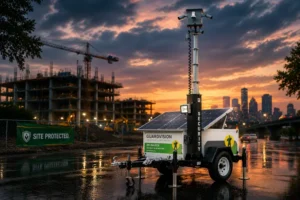
GuardVision offers two main trailer platforms in Texas. Titan Solar, a solar-powered mobile security camera trailer, carries its own power. Titan, a mobile security camera trailer that runs on site electricity with battery backup, suits sites that already have an outlet. Which one fits is part of the quote, not something to guess from a web page.
What’s included when you buy from GuardVision
GuardVision’s Texas trailer page lists these items with a purchase:
- Installation and configuration at your site, not just delivery of the equipment.
- A 1-year parts-and-labor warranty. Confirm the current terms with GuardVision before you rely on this.
- Financing, lease and service-agreement options, so a large payment doesn’t have to land all at once.
Your written quote is what counts. If something in that list matters to your decision, make sure it appears on the quote.
GuardVision sells, installs and services trailers in Texas only. Customers are businesses, not homeowners.
Costs after you buy
The purchase invoice is the day-one number. A trailer that stays on your site has a second set of costs, and they are easy to miss when you compare quotes.
| Ongoing cost | What to know |
|---|---|
Monitoring |
Cameras alone only record. Having people review alerts is a separate service, priced by the hours you choose. A month has about 730 hours, so “nights only” and “24/7” are very different bills. GuardVision’s live monitoring service is available nationwide for commercial sites, but only for LTS, GeoVision and UniFi camera systems. Monitoring can’t promise to catch every event or a set police arrival time. |
Data and software |
Ask whether the cellular plan and any cloud or software accounts are included, for how long, who owns the account, and what happens when they end. |
Service and repairs |
Warranties end. Ask what service costs afterward, and whether a service agreement covers visits, parts or both. |
Insurance |
Ask your insurance agent whether the trailer is covered on your policy, and for what kinds of loss. |
Moves between sites |
If the trailer will change locations, ask who moves it, what that costs and who points the cameras again. |
Taxes and paperwork |
Ask what sales tax, title or registration steps apply to your purchase, and confirm with your tax adviser. |
Wear and replacement |
Batteries and other parts wear out over time. Ask what a replacement looks like and who handles it. |
Want a quote with these lines spelled out?
Tell us the site, the power available and the hours you need covered.
Budget for 36 months, not just the invoice
A helpful planning window for ownership is 36 months, especially if you expect to move the trailer between jobs. It’s only a comparison window, not a promised useful life or a break-even date. Build the budget from your own written quotes:
Upfront purchase and setup + (36 × monthly costs) + (3 × yearly costs) + moves and repairs − estimated resale value
Explanation only. The 36-month period is an example, not a promised equipment life.
| Line item | Your quoted amount | One-time or recurring? |
|---|---|---|
Trailer, cameras and power |
—————— | One-time |
Delivery and first setup |
—————— | One-time |
Data and software |
—————— | Monthly or yearly |
Live monitoring, if chosen |
—————— | Monthly |
Service and maintenance |
—————— | As contracted |
Moves, insurance and storage |
—————— | As needed |
Possible resale value |
—————— | Estimate only |
Why the lowest quote can cost more later
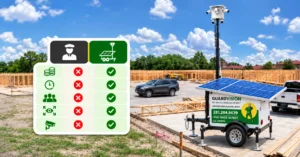
Imagine two written offers for the same Texas equipment yard. Quote A has a lower equipment total, but cameras, cellular service and setup are listed as extras. Quote B costs more at the start, but includes those items and describes the support plan.
You can’t say which is the better deal until both cover the same work. The fair comparison is ready-to-use system against ready-to-use system, followed by what each costs to keep working. Work through these five steps.
Bring a simple map and note broken lights, deep shadows, dark stair or walkway areas, glare, blocked views, and trees that hide corners. Photograph the problems and assign repair dates. If a fixture cannot be fixed before the peak shopping weekend, plan another approved way to cover the area.
01
Line up the equipment. Same power type, same camera count, same warning devices. If one quote leaves something out, ask whether it’s optional or missing.
02
Check who sets it up. Find out who installs, aims and tests the cameras at your site, and whether that work is on the quote.
03
Read the warranty. Look at the length, whether parts and labor are both covered, and who travels to the site to fix a problem.
04
Fill in the 36-month budget for each quote, with a real number on every line you can get.
05
Ask about the exit. If the job ends or the site changes, can you move it, store it or sell it?
If guards are also on the table, our guard vs. camera trailer cost comparison shows how to put the two on the same hours.
Three buying situations, three different quotes
A jobsite with no power. The manager expects the gate to move during the project. Battery reserve, cellular service and trailer moves deserve the most attention.
A long-term industrial yard. The site has dependable power and internet, and two entrances to watch all year. Compare a trailer with fixed cameras before assuming mobile equipment is the better purchase.
A contractor with jobs across Texas. The company plans to own one trailer and move it between sites. Ask about transport, repeat setup and who manages the system between jobs.
Not sure buying is right at all? The rent-or-buy guide covers that decision. To see how after-hours risk looks for your own property, try the risk calculator. Confirm this is the right calculator link.
What to send for a purchase quote
A good quote starts with a good brief. These details help us price your site, and they help you compare:
- Where: The city and address of each Texas site.
- Power and internet: Whether an outlet is nearby, or the site has no power.
- What to watch: Entrances, storage areas and the places you worry about most.
- After dark: Whether the area is lit, and what your team needs to see at night.
- Monitoring hours: None, nights only or around the clock.
- Payment: Pay in full, finance or lease.
- Timing and moves: When you need it, and whether it will change sites.
Frequently asked questions
How much does it cost to buy a security camera trailer?
It depends on the site, so GuardVision quotes each purchase in writing instead of listing one price. The quote reflects the trailer and power setup, the cameras and warning devices, delivery and setup, and how you pay. Costs after the purchase, such as monitoring and service, are on top of that.
Is installation included when I buy?
On GuardVision’s Texas trailer page, installation and configuration are listed with a purchase. Confirm exactly what that covers on your written quote, including who sets up and tests the cameras at your site.
Can I finance or lease a security camera trailer?
GuardVision lists financing, lease and service-agreement options for Texas purchases. Terms differ by site, so ask for the total of all payments, not just the monthly amount.
Does buying the trailer mean I own the cameras and software too?
Not necessarily. A quote may include some devices and leave others as options, and software or cloud services may need renewals. Ask for a list of what you own, what you license, and what stops working if a subscription ends.
Does the purchase include monitoring?
No. Monitoring is a separate service with its own hours and cost. GuardVision offers remote video monitoring for commercial sites nationwide, but only for LTS, GeoVision and UniFi camera systems. Ask us which option fits the trailer you’re considering.
Can I buy a GuardVision trailer outside Texas?
No. GuardVision sells, installs and services trailers in Texas only. Businesses in other states can still ask about remote video monitoring for a supported camera system.
Is a solar trailer more expensive to own than one on site power?
Not automatically. A site with ready power may need an electrician for the hookup, while a solar trailer carries its own power. Ask each quote to state the power plan, what is included, and what could add cost later.