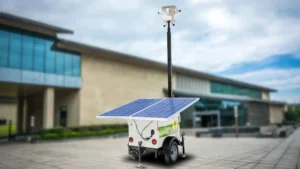
Quick answer: A solar security camera trailer is a camera system on wheels that makes its own power. Solar panels charge a battery bank by day, and the battery runs the cameras, recorder and cellular modem through the night. When a camera spots someone after hours, the trailer can flash lights, sound a siren and send an alert so a person can step in.
If you’ve driven past a construction site recently, you may have noticed a tall pole with cameras on top, solar panels, and a small trailer underneath. It may not look like much, but it does a lot. This trailer has its own power and internet connection, so it can help keep a construction site safe without needing electricity or internet from the site.
But how does it all work?
In this guide, we’ll take a closer look at how GuardVision’s mobile security camera trailers help Texas businesses keep their properties safe. We’ll go through the main parts, explain what each one does, and show you how they all work together.
You’ll also learn how the trailer keeps running after the sun goes down, even on long winter nights in Texas, and what happens if someone climbs over the fence at 2 in the morning.
How does a solar security camera trailer work?
A solar camera trailer, also sold as a solar surveillance trailer, does three jobs, around the clock:
- It makes and stores its own power. Solar panels turn daylight into electricity, and a battery bank stores it for nights and cloudy days.
- It watches. Cameras on a raised mast record day and night. Smart detection flags people and vehicles in the areas you choose.
- It acts. When something is flagged after hours, it can flash strobes, sound a siren and send a video alert over the cellular network. With live monitoring, an agent can also talk to the intruder through its speaker.
How power and alerts move through a solar camera trailer
1
Solar panels
Turn daylight into power
2
Charge controller
Splits it between gear and battery
3
Battery bank
Stores power for the night
4
Cameras and detection
Watch the site and flag people
5
Cellular modem
Sends alerts and live video
6
Live agent
Checks alerts, warns, escalates
No trenching, no outlet, no Wi-Fi. That’s the whole idea: security you can tow onto a site that has nothing, and move when the site changes.
The six parts of a solar camera trailer

01. Mast and cameras
The mast is a tall pole, usually telescoping, that lifts the cameras high above the ground. Height does two jobs. The cameras see over trucks, fences and stacked material, and they sit out of reach of anyone who wants to cover or cut them.
Titan Solar carries four HD cameras on its camera head, each aimed a different way. Some trailers rely on a pan-tilt-zoom (PTZ) camera instead. It can zoom in close, but while it points one way, it isn’t watching the other.
Height doesn’t erase blind spots, though. Containers, buildings and stacked material can still block a view, so where the trailer stands matters as much as how many cameras it has.
02. Lights, siren and speaker
This is the part that talks back. Bright strobes and a siren tell someone they’ve been seen, even if no one is watching yet. A speaker lets a live agent say it in plain words: “You in the gray hoodie, you’re on camera. Leave the site now.”
Titan Solar has red and blue strobes, a siren and voice warnings. You can see the horn speaker on the front of its camera head.
03. Power: solar panels and batteries
The panels are the trailer’s fuel. Titan Solar uses an 800-watt solar array, split across two large panels. That 800 watts is their rated size, not a steady output. Real output rises and falls with the season, clouds, shade and dust, and it stops at sunset, so the energy goes into a battery bank that runs everything after dark.
A small box called a charge controller sits between the two. It squeezes the most out of the panels and protects the batteries from being overcharged or drained too far.
04. Equipment cabinet
The locked cabinet is the trailer’s control room. It usually holds the battery bank, the charge controller, the recorder that stores video on the trailer, the processor that runs detection, and the cellular modem.
It’s sealed against rain and dust, with vents on the side. That matters in Texas, where a closed metal box sits in full sun all summer.
05. Trailer base
Wheels, a hitch and leveling jacks. The trailer tows behind a pickup, and the jacks level it and hold it steady so the mast doesn’t sway in the wind. When the work moves to the other end of the site, the coverage moves with it.
06. Connection
This is the part you can’t see in a photo. A cellular modem, much like the one in your phone, sends alerts, clips and live video off the site. Most trailers also record on board, so a weak signal delays what gets sent instead of erasing it.
No Wi-Fi doesn’t mean no signal. Check coverage at the exact spot the trailer will stand, not just somewhere on the property.
Mobile surveillance trailer parts at a glance
| Part | Its job | What to ask a provider |
|---|---|---|
1 Mast and cameras |
See over obstacles, out of reach | How high does the mast go, and how many cameras? |
2 Lights, siren and speaker |
Tell intruders they’ve been seen | Can a live agent talk through the speaker? |
3 Solar panels and batteries |
Make and store power | How many days does it run without sun? |
4 Equipment cabinet |
Record, detect, protect the electronics | Where is video stored, and for how long? |
5 Trailer base |
Move, level and steady the system | Who moves it when the site changes? |
6 Connection |
Send alerts and live video | Which carrier, and what if the signal is weak? |
How solar power keeps it running, day and night
Think of the battery as a bank account. The panels make deposits while the sun is up, and the cameras, recorder, modem and lights make withdrawals every minute, day and night. The trailer stays on as long as the deposits keep up, with enough saved to ride out a run of gray days.

By day the panels run the gear and refill the battery. By night the battery carries everything: 13 h 46 m on the shortest day of the year in Houston.
Daytime: the panels do double duty
In daylight, the panels run the equipment and fill the battery at the same time.
Nighttime: the battery carries everything
After sunset, nothing comes in, and the battery runs everything until morning. That’s why winter is the real test.
On the shortest day of the year, Houston gets about 10 hours and 14 minutes of daylight, almost four hours less than in June. So in late December, a trailer runs on its battery for close to 14 hours straight. Winter sun is weaker, too: around Houston, a solar panel collects roughly half as much energy on an average winter day as on a summer day.
A quick example with round numbers
These are example numbers to show the math, not Titan Solar specs.
- Say the equipment draws an average of 40 watts, around the clock. That’s 960 watt-hours a day.
- An 800-watt array in a Houston winter makes roughly 2,600 watt-hours on an average day, before some loss in charging and wiring. That still refills about twice what the gear uses.
- On a heavy overcast day, output can drop to a small fraction of that. The battery covers the gap, and how long it can do that alone is called days of autonomy.
Nighttime: the battery carries everything
After sunset, nothing comes in, and the battery runs everything until morning. That’s why winter is the real test.
On the shortest day of the year, Houston gets about 10 hours and 14 minutes of daylight, almost four hours less than in June. So in late December, a trailer runs on its battery for close to 14 hours straight. Winter sun is weaker, too: around Houston, a solar panel collects roughly half as much energy on an average winter day as on a summer day.
Cold snaps
Texas freezes are rare, but they happen. Many newer trailers use lithium batteries, which shouldn’t be charged below freezing without built-in heating or cold-weather charge limits. Ask how the trailer handles a hard freeze before one shows up in the forecast.
How a camera trailer works at night
Night is when a trailer earns its keep. At 37 Texas sites where GuardVision trailers were monitored from January to September 2026, 80% of the 412 verified incidents happened between 6 p.m. and 6 a.m.

We count a verified incident as an alert that an agent confirmed was a person or vehicle where they shouldn’t be.
Seeing in the dark
After sunset, most security cameras switch to night mode. Small infrared (IR) lights around each lens flood the scene with light people can’t see, but the camera can. The picture turns black and white, and people and vehicles still show up within the IR range.
Some trailers add white lights. Visible light lets cameras record in color, and it doubles as a warning: nobody likes standing in a spotlight.
Knowing what matters
A camera that alerts on every moving shadow gets ignored by morning. So modern trailers use video analytics, usually called AI detection. It decides whether a moving shape is a person, a vehicle or something to skip, like a stray dog or a flapping tarp.
You can also limit detection to zones, such as the gate or the copper container, and to hours, such as after the crew leaves. Titan Solar’s detection is built to tell people and vehicles apart from animals.
What happens at 2 a.m.: a step-by-step walkthrough
Here’s a typical night on a monitored jobsite. It follows GuardVision’s real monitoring steps, but the scene is an example: actual timing depends on the site, the signal and its response plan.

- 2:07 a.m. Someone hops the back fence. The site has been empty since the crew left at 5:30. Two of the trailer’s cameras pick up a person walking toward the material container.
- The trailer flags it. Detection marks the shape as a person inside a watched zone during armed hours. A short clip goes out over the cellular link.
- An agent checks it. A monitoring agent watches the clip and the live view to confirm it’s someone who shouldn’t be there, not a shadow, an animal or a late delivery. This human check is what keeps the police from being called for a raccoon.
- The trailer talks. The strobes flash, and the agent speaks through the speaker: “You by the blue container, you’re on camera and we’re watching live. Leave now.”
- Most people leave. At GuardVision’s Texas trailer sites, 7 in 10 verified incidents ended with the intruder leaving after the live warning.
- If they stay, the agent escalates. The agent follows the site’s response plan. That can mean calling your site contact, calling the police with a description of what’s happening, or both. No monitoring company can promise when police will arrive; that depends on the local agency.
- By morning, there’s a record. The incident is logged with its clips, and you’re notified when it needs your attention.
Does every solar surveillance trailer come with live monitoring?
No. Live monitoring is an optional service you add to the trailer. Without it, the trailer still records, flashes its strobes, sounds the siren and sends an alert to your phone. The real question is who sees that alert at 2:07 a.m.
If the answer is nobody until 7, the footage tells you what happened, but no one could step in while it was happening. A large review of 40 years of camera studies found that actively monitored systems were tied to bigger drops in crime than passive ones.
On a GuardVision trailer, you can choose 24/7 coverage or set hours, like nights and weekends. For a site that sits empty overnight, it’s the part that turns video into a response.
From delivery to cameras watching
Across GuardVision’s 2026 Texas deliveries, the median time from signed agreement to cameras watching was 26 hours.
- Pick the spot. Cover the ways in first: gates, fence gaps and the road in. Keep high-value storage in view and give the panels open sky.
- Aim and test. The cameras are aimed at the areas that matter, and the connection is tested from the site. A night check shows how headlights, shadows and site lights change the view.
- Set the rules. Detection zones and armed hours are set to match when the site is empty, and you choose who gets called when an alert is real.
- Go live. Video starts recording, alerts start flowing, and monitoring begins if you’ve added it
- Tow and park. The trailer arrives behind a pickup and parks on firm, level ground where equipment won’t back into it and no emergency route is blocked.
- Level and raise. The jacks go down, the trailer is leveled, and the mast goes up.
GuardVision sells, rents, installs and services its trailers in Texas only, delivering from Pearland. Outside Texas, it can’t deliver a trailer, but it can monitor existing commercial LTS, GeoVision or UniFi camera systems nationwide.
Is a solar camera trailer the right tool for your site?
A solar trailer isn’t always the answer, and it’s worth knowing when.
It’s usually a good fit when:
- There’s no power or internet on site yet.
- The layout keeps changing, like a build that moves in phases.
- You need to watch a big open area: a laydown yard, an equipment lot or a parking lot.
- You need coverage fast, often right after a break-in.
- An insurer, owner or general contractor wants security in place before work starts.
Something else may fit better when:
- The building is permanent and already has power and internet. A fixed system usually makes more sense, like Maxx, GuardVision’s permanent security camera system.
- You only need height in one fixed spot. Apex Solar and Apex, GuardVision’s pole-mounted security cameras, can do that without a trailer.
- The only open spot sits in heavy shade. Titan, a mobile security camera trailer that runs on battery or generator power, may suit that site better.
Even in the right spot, a solar-powered security trailer is one layer of protection. It can’t physically stop anyone, so fencing, lighting and locks still matter.
Frequently asked questions
How does a solar security camera trailer work at night?
It runs on the battery bank that the solar panels charged during the day. After sunset, the cameras switch to infrared night vision, detection keeps watching for people and vehicles, and the strobes, siren and speaker can respond.
Does a solar camera trailer need Wi-Fi or an outlet?
No. The solar panels and batteries supply the power, and a built-in cellular modem sends alerts and video. What it does need is open sky for the panels and a usable cell signal where it’s parked.
How long can a solar camera trailer run without sun?
It depends on the battery bank’s size and how much power the equipment draws. Ask the provider how many days it runs on battery alone and who gets alerted when the battery runs low. A real answer names a number and a person.
Does someone watch the cameras live?
Only if you add live monitoring. Then an agent reviews each alert, can speak to intruders through the speaker and follows your response plan. GuardVision offers 24/7 or custom hours.
Can the trailer be moved during a project?
Yes. When work shifts to another part of the site, the trailer is towed, leveled and aimed again, so the cameras keep watching what’s at risk.
Who installs and services GuardVision trailers?
GuardVision does, in Texas only. Trailers are delivered, set up and serviced from Pearland, and rentals include maintenance and service.