THE SHORT ANSWER
A surveillance camera trailer rental typically provides a mobile unit with cameras, a mast, and a power system for the agreed rental period. Connectivity, recording, remote viewing, delivery, setup, and maintenance depend on the package. Staffed live monitoring may be an optional service. Ask for a clear list of inclusions, then check at handover that the agreed cameras, access, alerts, and support arrangements are working.
A trailer arrives at a construction site. The cameras are raised, and the project manager can open a live view on a phone. Is everything ready for the weekend?
That depends on what was ordered. Recording may be active while professional monitoring has not started. A camera may show the gate while leaving the material storage area out of view. A login may allow viewing but not downloading footage.
This guide explains how to turn the words in a rental offer into a system your team knows how to use. For site-specific options, see GuardVision’s mobile security camera trailers for Texas businesses.
What does a camera trailer rental package contain?
Think about the rental in three parts: the equipment supplied, the services activated, and the responsibilities agreed with your team. A description such as “fully equipped” does not answer all three.
01
Equipment supplied
The trailer, cameras, mast, power equipment, and specified accessories.
02
Services activated
The agreed connection, recording, user access, alerts, and monitoring option.
03
Responsibilities agreed
Who handles faults, site changes, incident follow-up, and collection.
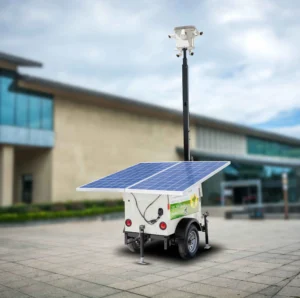
The physical equipment may include solar panels and batteries, a cellular modem, a recorder, warning lights, or a speaker. The exact configuration belongs on the equipment list for your rental. Avoid assuming that every trailer has the same cameras, recording capacity, or power arrangement.
Services vary between providers and packages. For example, Street Smart’s rental information distinguishes customer viewing and alerts from optional live monitoring and cloud backup. A feature being available does not establish that it is part of the offer you received.
If you also need budget guidance, our article on security camera trailer rental costs in Texas explains pricing. Here, the key question is what your team will receive and be able to do.
What should be confirmed before delivery?
The equipment and the areas it will cover
Ask the provider to name the trailer model and identify the areas the installation is intended to cover. A marked site plan or a few labeled photos can make this much clearer than a camera count alone.
For a logistics yard, the important views might be the entrance lane and parked trailers. At a dealership, they might be the vehicle display rows and service entrance. State the task: seeing that someone entered an area is different from needing a clear view of a particular vehicle or doorway.
Also identify equipment that is optional, such as an additional camera or a different power arrangement. Keep the technical detail tied to the view or function your site needs.
Power, connection, and access
Confirm which power and connection services the provider supplies and which, if any, the site must supply. For a solar rental, ask the installer to assess the proposed position and explain who handles a low-battery or charging problem.
If cellular service is part of the package, confirm that the data service is active, who pays for it, and whether usage limits affect remote viewing or footage transfers. “Cellular capable” describes equipment; an active data service makes the connection usable.
Finally, name the people who need access. A regional manager, site supervisor, and overnight contact may need different permissions. Agree who can view cameras, retrieve recordings, change schedules, and request support.
What should you receive at the rental handover?
Ask for a short handover record that connects each promised function to a check someone has completed. This gives your team a reference when shifts change or a new site manager takes over.
The following is a suggested acceptance checklist, not a statement of GuardVision’s standard rental terms.
| Record this | Check it together |
|---|---|
Trailer and coverage |
Match the delivered unit to the agreed equipment. Open each camera view and identify the areas it covers. |
User access |
Have an authorized site user sign in on their own device and use the permissions they need. |
Recording and retrieval |
Play back a test event. Confirm how to request or export a clip, the recording schedule, and how long footage is kept. |
Alerts and monitoring |
Confirm the active schedule, alert recipients, and monitoring start time if that service was selected. |
Equipment problems |
Record who receives connection or power fault notices, who opens a support request, and the support contact. |
Open items |
List any unfinished checks, the person responsible, and the next action. Include a night-view check if still needed. |
Coordinate any alert test with the provider first. A planned test should be identified as a test so it can be checked without an unnecessary escalation.
Ask to see the views under the conditions that matter. If the concern is overnight access, agree how a nighttime check will be completed. A daytime image alone does not establish what the camera will show after dark.
A simple handover example
Illustrative scenario: A warehouse yard rents a trailer to cover its vehicle gate and outdoor inventory. During handover, the manager can see the gate, but a newly parked container blocks the inventory view.
The handover record identifies the missing view. The provider and site team agree on a revised position or another suitable arrangement, then check the views again. The manager also confirms who will receive alerts while the warehouse is closed.
That is a useful acceptance check because it connects the rental to the reason the equipment was ordered. A delivery signature by itself leaves those operating details unresolved.
Is live monitoring included in a surveillance camera trailer rental?
It depends on the package. With GuardVision, professional live monitoring is optional. Confirm the selected service and its start time before your team relies on it.
Three functions need separate answers:
- Recording: What video is stored, and how can your team retrieve it?
- Automated alerts: What activity generates a notification, and who receives it?
- Human review: Who reviews relevant activity during the agreed hours and follows the response instructions?
App access does not mean someone else is reviewing alerts. A speaker fitted to a trailer does not, by itself, confirm that an operator will use it.
If you choose monitoring, document the coverage hours, holiday changes, authorized workers, contact order, and actions available under the plan. Ask how requests to change those details are confirmed. Avoid leaving an old supervisor as the only contact after a staffing change.
Our guide to how remote video monitoring works explains the service in more detail. For this rental decision, establish who is responsible for reviewing alerts during every period you expect coverage.
Monitoring also has limits. Escalation follows the agreed plan, and law-enforcement attendance or arrival time cannot be guaranteed.
What support continues during the rental?
Clarify how equipment care works once the installer leaves. “Support included” should lead to a usable contact and a clear process for reporting a problem.
Faults, maintenance, and service visits
Ask who checks equipment health and who tells your team when a camera, recorder, connection, or power system needs attention. A security alert and an equipment fault are different events; both need an owner.
Confirm which issues can be handled remotely, when an on-site visit may be needed, and whether a temporary replacement is available. Get the actual service terms for your location. Do not turn a general promise of support into an assumed repair deadline.
Routine service and damage also need separate answers. Ask which maintenance is covered and what happens if site equipment strikes the trailer or someone moves it without authorization.
Changes to the site or the trailer’s position
Tell the provider when a gate moves, stock blocks a view, working hours change, or new personnel need access. Name someone on your team to communicate these changes.
If the trailer needs moving, confirm who is authorized to move it and what service is included. Agree how camera views, connection, recording, and alert schedules will be checked afterward. Moving the equipment can change the setup that was accepted at the first handover.
What happens to the service and footage at pickup?
Collection has an operational side as well as a transport side. Confirm when recording and any monitoring end, when the unit will be collected, and when your user access closes.
If you need footage from the rental, arrange retrieval before the relevant recording is overwritten or access ends. Ask what happens to recordings stored on the unit or in any cloud service after collection.
Keep pickup arrangements, responsibility for moving the unit, and any related charges clear. If the project continues, confirm the extension and monitoring schedule before the current arrangement ends.
What can you expect from a GuardVision rental in Texas?
GuardVision rents, installs, and services mobile security camera trailers for commercial customers in Texas. Our Texas trailer page lists maintenance and service as included with rentals, along with app access for live viewing and playback. Delivery is included for most Texas sites; confirm the arrangement for your address.
Live monitoring can be added to the rental. The written proposal should identify your equipment, selected monitoring hours, setup arrangements, and any site-specific services or charges.
For the equipment itself, you can also review the Titan Solar trailer. Confirm the model and configuration available for your project rather than carrying specifications from another rental into your plan.
Frequently asked questions
Does “24/7” mean a person watches every camera continuously?
Ask what the term describes: recording, technical support, or staffed monitoring hours. Confirm whether monitoring involves reviewing alerts, scheduled checks, or another agreed method. The phrase alone does not define how attention is assigned to your cameras.
Is cloud video storage included?
Do not assume it is. Ask whether footage is stored on the trailer, in the cloud, or both. Confirm what is retained, for how long, how clips are retrieved, and whether cloud storage or exports have separate terms.
Can our team control the cameras from a phone?
Viewing access and camera control are different permissions. Ask which functions your account allows. If remote movement or zoom is available, confirm who can use it and whether changing a view affects an agreed coverage area.
Does the rental include someone who can physically secure the site?
A camera trailer does not perform on-site tasks such as closing a gate, checking a delivery driver’s identity, or moving a barrier. Assign those tasks to your site team or a separately arranged service.